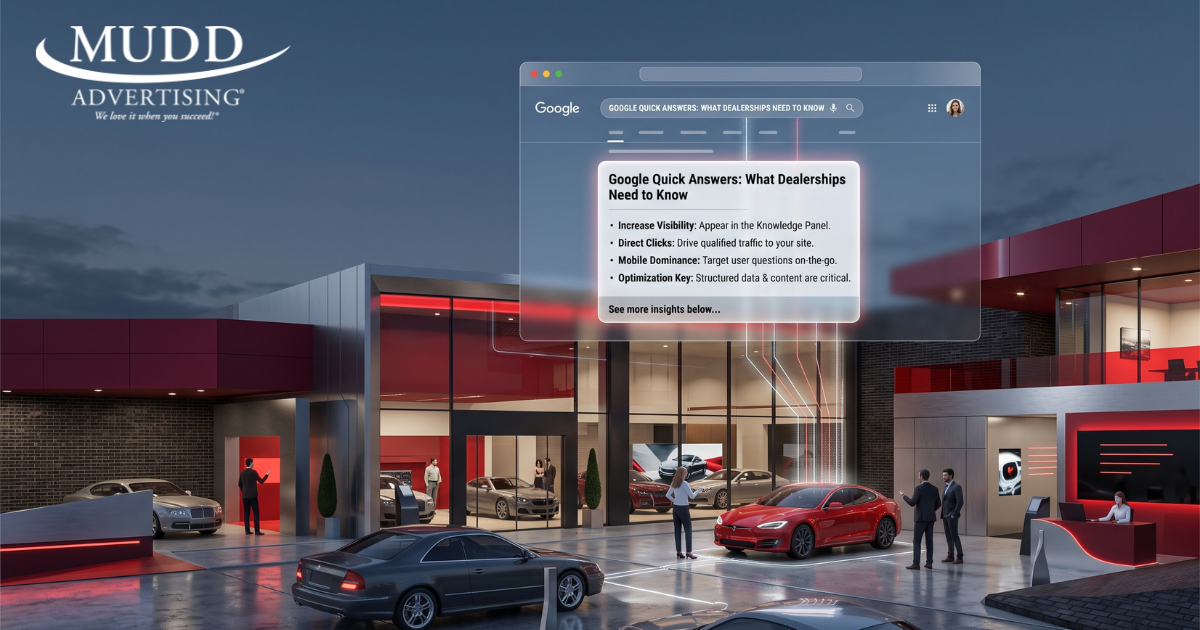
Google Quick Answers: What Dealerships Need to Know
Search a question on Google and, more often than not, you won't even have to click a result to get your answer. A box appears right at the top of the page — above the traditional blue links — with the exact information you were looking for, pulled directly from a website and displayed in a highlighted snippet. That's a Google Quick Answer, and for car dealerships, it's quickly becoming one of the most valuable pieces of digital real estate on the internet.
What Exactly Is a Google Quick Answer?
A Google Quick Answer (sometimes called a "featured snippet") is a short block of text, list, or table that Google lifts from a webpage and displays at the very top of the search results page when it determines that content directly answers a searcher's question. Alongside the snippet, Google shows the source page's title and link, so the business behind that answer gets credited — and clicked.
Google's system scans indexed pages, evaluates which one best satisfies the intent behind a search, and promotes that content into the answer box. It's not a paid placement. It's earned through content that's clear, well-structured, and genuinely useful to the person asking the question.
For car shoppers, these questions are everywhere: "How often should I rotate my tires?" "What's the difference between a lease and a loan?" "How much does it cost to replace a windshield?" Whichever dealership's website answers that question best has a real shot at owning that spot.
Why Quick Answers Matter for Automotive Marketing
They capture attention before anyone else gets the chance. Quick Answers sit above the first organic listing, which means a dealership can win the most visible spot on the page even without holding the #1 ranking. A well-written service FAQ or buying guide can outperform a page from a much larger competitor simply by answering the question more directly.
They build trust at the exact moment a shopper is deciding where to go. Car buying involves a lot of research — financing terms, maintenance schedules, trade-in value, vehicle comparisons. When your dealership's content is the one Google trusts enough to feature, it signals authority before the shopper has even landed on your site.
They drive qualified traffic, not just impressions. Someone who clicks through from a Quick Answer already knows your dealership had the answer they needed. That's a warmer visitor than one arriving from a generic ad, and it often shows up in stronger engagement and better conversion rates on service and sales pages alike.
They set the stage for AI-powered search. Quick Answers are close cousins to the answers now generated by AI Overviews, ChatGPT, and other AI-driven search tools. The same content practices that earn a featured snippet — clear structure, direct answers, credible sourcing — are what these newer platforms pull from too. Optimizing for Quick Answers today builds the foundation for staying visible as search continues to shift toward AI-generated results. It's exactly why Mudd Advertising's digital team builds dealership content with both audiences in mind from the start — writing pages that satisfy a Google algorithm and an AI assistant at the same time, instead of chasing one and hoping the other follows.
What It Takes to Win the Spot
Landing a Quick Answer isn't about gaming an algorithm — it's about making content genuinely easier for both Google and real shoppers to use. A few practices consistently help:
• Answer the question immediately. Lead with a direct, concise answer before adding supporting detail. If someone asks "What's included in a 30,000-mile service?", the first sentence should answer it — not the fifth paragraph.
• Use clear formatting. Numbered steps, bulleted lists, and short tables are far more likely to be pulled into a snippet than dense blocks of text.
• Structure pages around real questions. FAQ sections, service pages, and buying guides built around the actual phrases customers search for give Google more opportunities to match your content to a query.
• Back it up with structured data. Schema markup helps search engines understand exactly what a page is answering, making it easier for that content to be recognized and featured — the kind of technical groundwork Mudd Advertising's team builds into every dealership site it manages.
• Keep it accurate and current. Google favors content that reflects up-to-date pricing, policies, and information — especially for anything related to service, financing, or inventory.
| Question Type |
Example |
Best Format |
Why It Wins |
| Definition |
"What's the difference between a lease and a loan?" |
Short paragraph |
Google favors a direct, self-contained answer in the first 1–2 sentences. |
| Process |
"How do I trade in a car with a loan balance?" |
Numbered steps |
Sequential steps map directly to Google's step-by-step snippet format. |
| Comparison |
"Sedan vs. SUV: which is better for towing?" |
Table |
Side-by-side data is easiest for Google to lift and display as-is. |
| Cost |
"How much does a brake replacement cost?" |
Bulleted list or table |
A scannable price range or breakdown answers the question at a glance. |
| Yes/No |
"Can I get pre-approved before visiting the dealership?" |
Short paragraph |
A direct yes/no answer up front, with brief supporting detail. |
The Bottom Line
Quick Answers reward dealerships that treat their website as a genuine resource for customers, not just a digital brochure. The dealerships that consistently answer real questions — about service, financing, trade-ins, and ownership — are the ones showing up first, building trust early, and turning that visibility into showroom and service-bay traffic.
As search continues to evolve, that same foundation of clear, question-driven content is exactly what keeps a dealership visible — whether the answer is displayed in a classic Google snippet or generated by an AI assistant. Mudd Advertising has spent 45 years focused exclusively on automotive marketing, and its team of digital experts knows the questions car shoppers ask and how to build the content, schema, and site structure that positions dealerships as the answer — on Google today, and on whatever search looks like tomorrow.