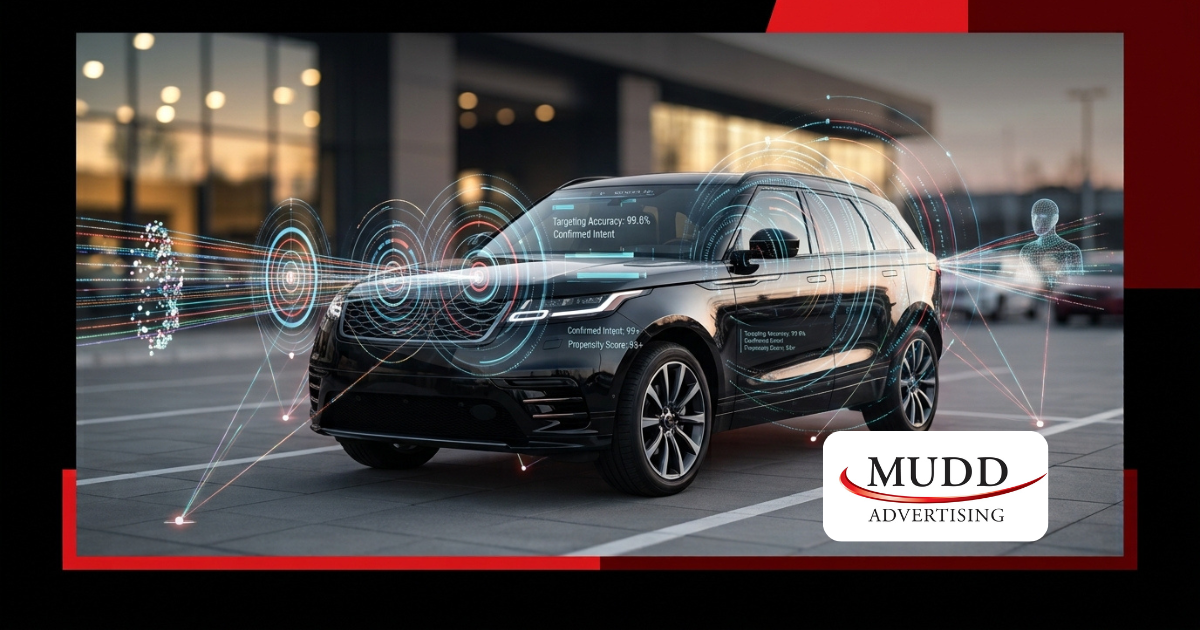
Stop Marketing to Everyone: Why “In-Market” Targeting Is the Only Strategy That Matters for Vehicle Sales
For decades, automotive marketing has leaned on demographics as a proxy for intent. Target adults 25–54 in a 15-mile radius with a household income above $75,000, and hope enough of them happen to be shopping for a vehicle right now. It's a strategy built on probability, not evidence — and in a market where dealers are paying more per lead every year, probability isn't good enough anymore.
The dealers winning today aren't targeting who might buy. They're targeting who's actively looking — right now, for a specific vehicle, at a specific price point. That's the difference between demographic targeting and in-market targeting, and it's reshaping how smart agencies build campaigns.
The Problem With Demographic Targeting
Demographics answer a narrow question: what does this person's profile look like on paper? They don't answer the question that actually drives a sale: is this person shopping for a car today?
A 42-year-old suburban parent with two kids and a $90K household income fits the “profile” of an SUV buyer. But that same description applies to millions of people who bought their SUV eighteen months ago and won't be back in a showroom for years. Spend against that audience, and a dealership is paying to reach people who have already made their decision — or won't make one for a long time.
In-market targeting flips the model. Instead of asking “who looks like a buyer,” it asks “who is behaving like a buyer, right now.” That distinction is the difference between a media plan that reaches an audience and one that reaches a customer.
What “In-Market” Actually Means
In-market targeting identifies consumers based on active, observable shopping behavior rather than static profile data. It's built on behavioral signals — the digital footprint someone leaves while actually car shopping — combined with first-party data an agency or dealer group already owns.
Signals agencies use to identify in-market shoppers include:
• VDP (vehicle detail page) visits on a dealer's own site or across a group's network
• Search behavior tied to specific vehicle types, trims, and price bands — “SUVs under $30k,” not just “SUV”
• Inventory and payment-calculator interactions, which signal budget-qualified intent
• Trade-in and valuation tool usage, a strong predictor of near-term purchase timing
• CRM and DMS data showing service visits, lease-end dates, and warranty timelines
• Cross-site behavioral data from data co-ops and automotive-specific ad exchanges
• Repeat visitation patterns across competitive inventory, indicating active comparison shopping
Individually, each signal is useful. Combined and matched back to a real household, they produce something demographic targeting never could: a live, qualified audience of people who are actually in the market.
Why Precision Beats Reach
The gap isn't just theoretical. In a pilot across ten stores, in-market audiences built on first-party and behavioral data matched back to actual vehicle purchases at a 37.4% buyer match rate — at a cost of just $233 per unit sold. That's a level of accountability broad demographic campaigns simply can't produce, because there's no way to connect an impression served against “adults 25–54” to a VIN sold in a dealer's showroom.
The Pre-Market Advantage
One of the most overlooked benefits of in-market, first-party-driven targeting is how early it identifies a shopper. Behavioral signals — a lease approaching its end, a trade-in valuation search, repeated visits to competitive inventory — often surface 40% of a dealership's eventual buyers before those shoppers have ever engaged with a demographic-based campaign at all. Reaching someone in that pre-market window, rather than waiting for them to show up in a broad retargeting pool, is what allows a dealer to influence the shopping journey instead of just bidding for attention at the end of it.
Where MuddVision Fits
MuddVision is built on a different premise than most platforms: people before platforms. Instead of starting from anonymous clicks, device IDs, or cookie-based look-alikes, MuddVision starts with verified, real people — identified through Mudd's data access to Equifax. Every audience begins as an actual named individual or household, not a demographic estimate without a name attached.
That starting point changes what a dealership is actually building. Anonymous impressions can generate reach, but they can't build brand equity in a market — you can't earn recognition and trust with traffic you can't identify. By identifying real people first, MuddVision lets a dealer build genuine brand equity in its market while simultaneously constructing in-market audience segments at the individual and VIN level.
From that foundation, MuddVision layers in first-party CRM and DMS data, along with the behavioral signals, to activate those verified audiences with precision.
The results compound: campaigns built on MuddVision data have driven a 6:1 return on ad spend and 62% reach across four channels, because the media dollars are only ever working against real, verified people who are already in the market. Comparing that performance to the $739 average cost-per-sale benchmark reported by NADA makes the case even clearer — starting with people, not platforms, doesn't just perform better, it costs less to get there.
Building a Vehicle Marketing Strategy Around Intent
For dealers and dealer groups building a media strategy today, the shift to in-market targeting isn't optional — it's the difference between a campaign that generates impressions and one that generates units sold. A strategy built around in-market audiences typically includes:
1. Auditing existing
first-party data across CRM, DMS, and website analytics to identify what signals are already being captured and underused
2.
Layering behavioral and intent data — search, VDP visits, calculator use — on top of that first-party foundation
3. Building specific, price- and vehicle-
qualified audiences, rather than broad make/model or demographic segments
4. Activating those audiences across channels with consistent creative and offers matched to where each shopper is in the journey
5. Measuring against
VIN-level matchback, not impressions or clicks, to prove real sales impact
Agencies that still lead with demographic targeting are optimizing for reach. Agencies building on in-market, first-party-driven strategy — the approach MuddVision was purpose-built to power — are optimizing for sold units. For dealers, that's the only metric that was ever supposed to matter.
With 45 years of automotive-only experience and over 10,000 dealers served, Mudd Advertising turns first-party signals into in-market audiences that drive real sales, not just impressions.