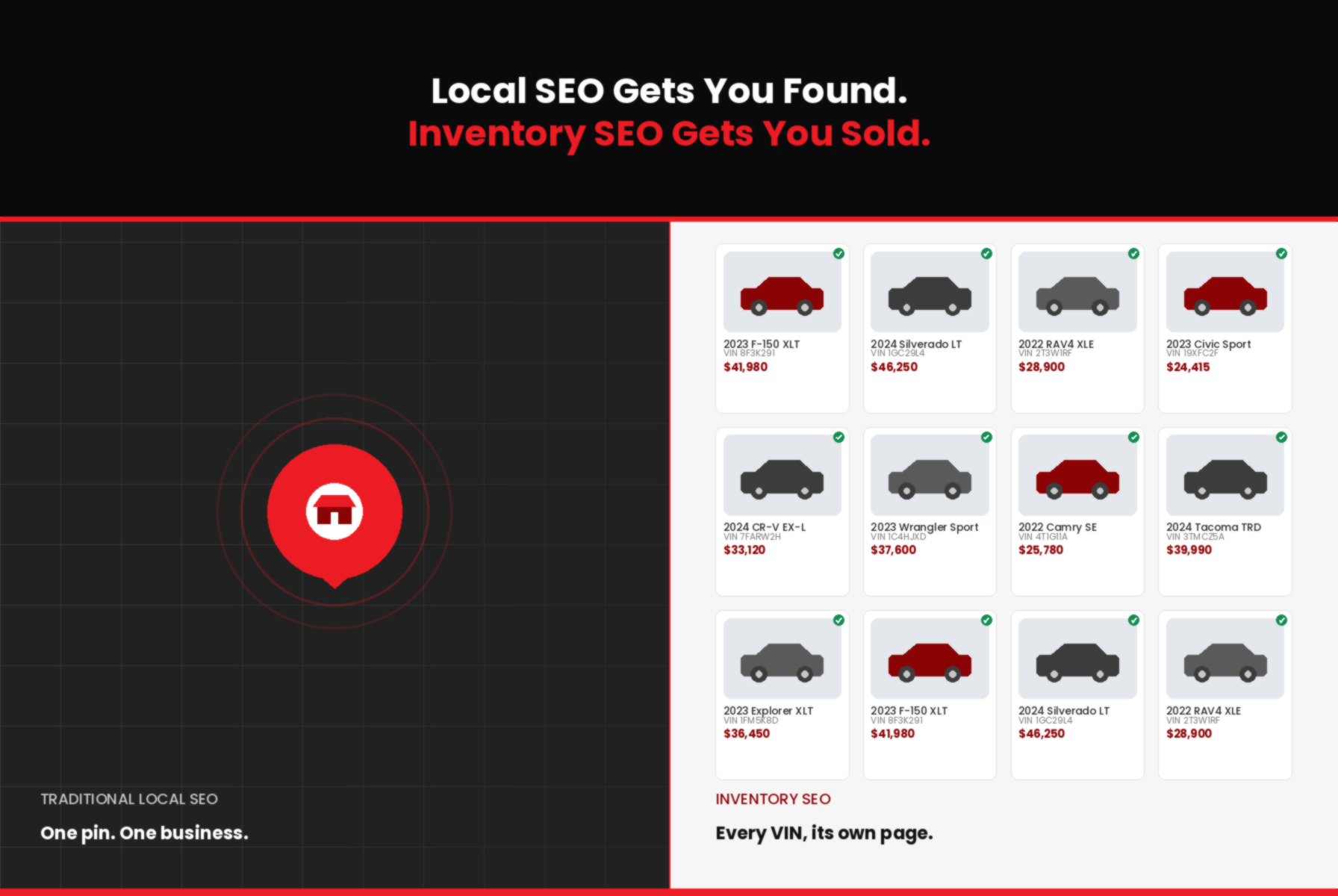
The homepage isn't where car buyers start their search
Most local businesses live or die by one question: does the business itself show up when someone searches nearby? A plumber, a dentist, a coffee shop — their entire SEO strategy can reasonably center on the business name, the service area, and a handful of "near me" keywords pointing at one homepage or location page.
Car dealerships don't get that luxury, and treating dealership SEO like a scaled-up version of local SEO is one of the most common — and costly — mistakes in automotive marketing. A dealership isn't one business with one thing to find. It's a business selling hundreds or thousands of individual products, each with its own name, price, trim, mileage, and identity, changing on a near-daily basis as inventory turns.
Search engines, and increasingly AI answer engines, have adapted to that reality. Shoppers aren't typing "Chevy dealer near me" nearly as often as they're typing "2023 Chevy Silverado 1500 LT under 30k miles" or asking an AI assistant "what's a fair price for a used Silverado with under 40,000 miles?" If a dealership's SEO strategy stops at the homepage and a set of location pages, it's invisible for the searches that actually lead to a sale.
What "Inventory SEO" means — and why it's the real differentiator
Inventory SEO is the practice of making sure individual vehicles, not just the dealership as a whole, are discoverable in search. That means:
• VIN-level pages that are actually indexable and unique. Many dealership websites generate inventory pages through a feed or DMS integration that produces thin, templated, near-duplicate content across hundreds of vehicles. Search engines routinely skip indexing these because they don't look distinct enough to be worth ranking. A real Inventory SEO approach means unique title tags, meta descriptions, and enough distinct content per VIN (condition notes, feature callouts, local relevance) that each listing can stand on its own in search results.
• Model landing pages that rank independent of any single VIN. A shopper researching "2024 Ford F-150 for sale in [city]" isn't always looking for one specific truck — they're evaluating whether this dealership has the F-150 selection, trims, and pricing worth their time. A dedicated, well-optimized model landing page (updated as inventory shifts, not a static brochure page) captures that research-phase traffic before a shopper narrows to a single VIN.
• Structured data at the vehicle level. Schema markup (Vehicle, Product, Offer) on individual listings is what allows both traditional search engines and AI search tools to understand and surface specifics — price, mileage, trim, availability — directly in results, not just a link to "browse our inventory."
• A content strategy that treats inventory as a living asset, not a static export. Inventory SEO isn't a one-time setup; it requires ongoing technical maintenance as vehicles sell, prices change, and new stock arrives, because stale or delisted VINs create broken experiences that actively hurt search trust.
This is the core difference from traditional local SEO: a dealership's search visibility is won or lost at the product level, not just the business level. Ranking the homepage for "[Brand] dealer in [city]" is table stakes. Ranking individual model pages and VINs for the searches that happen during active shopping is where the volume — and the AI-search visibility — actually lives.
Comparison of traditional local SEO and automotive inventory SEO across seven dimensions, including what gets optimized, structured data, and AI answer engine visibility.
| Dimension |
Traditional Local SEO |
Inventory SEO (Automotive) |
| What gets optimized |
The dealership as a single business entity |
Individual VINs and model landing pages, plus the dealership overall |
| Typical search query |
“Chevy dealer near me” |
“2023 Silverado 1500 LT under 30k miles [city]” |
| Content lifespan |
Static — set once, updated occasionally |
Constantly shifting as inventory turns; requires ongoing maintenance |
| Structured data |
LocalBusiness / Organization schema |
Vehicle, Product, and Offer schema at the listing level |
| Ranking unit |
One homepage, a few location pages |
Hundreds or thousands of unique, indexable pages |
| AI answer engine visibility |
Limited to brand + location questions |
Extends to model-specific and vehicle-specific questions |
| Success metric |
Visibility for branded + “near me” terms |
Traffic and leads on specific models, trims, and VINs |
Geo content has to answer questions, not just claim a location
Traditional local SEO leans heavily on geo-modified keywords: city name plus service, city name plus business type. That still matters for dealerships, but it's not sufficient on its own, especially as AI search tools shift from matching keywords to answering questions.
The more effective approach is building content around the real questions shoppers and owners are asking that naturally lead them toward a dealership — questions like:
- "How much does it cost to replace brake pads on a [model]?"
- "What's the towing capacity of a [model] with the [trim/engine]?"
- "How often does a [model] need an oil change?"
- "Is [model] or [competitor model] better for a growing family?"
- "What should I check before buying a used [model]?"
- "Does [model] still have full warranty coverage at [X] miles?"
These are the moments where a shopper or owner is actively looking for expertise, not just a business listing. A dealership that publishes clear, specific answers to these questions — organized by model and by service — positions itself to be the source an AI answer engine pulls from, and the click a search engine surfaces, well before that person has decided which dealership to visit.
This is where GEO content and inventory SEO reinforce each other: a service FAQ page for a specific model can link directly into that model's landing page and current inventory, turning an informational question into a path toward a lot visit or a service appointment.
What this means for how dealership SEO should actually be structured
Put together, a dealership's search strategy needs three layers that traditional local SEO doesn't require:
1. Foundational local SEO — Google Business Profile, NAP consistency, location pages, review management. Necessary, but not sufficient.
2. Inventory SEO — indexable, unique VIN pages and model landing pages with vehicle-level structured data, maintained continuously as stock turns.
3. Question-driven GEO content — service and model-specific content built around the actual questions shoppers and owners ask, structured so both traditional search and AI answer engines can surface it and connect it back to inventory.
Dealerships that only build the first layer are competing for a much smaller, more generic slice of search traffic — and are largely invisible to the model- and vehicle-specific questions now driving AI-assisted car shopping.